
 alishanasir237@gmail.com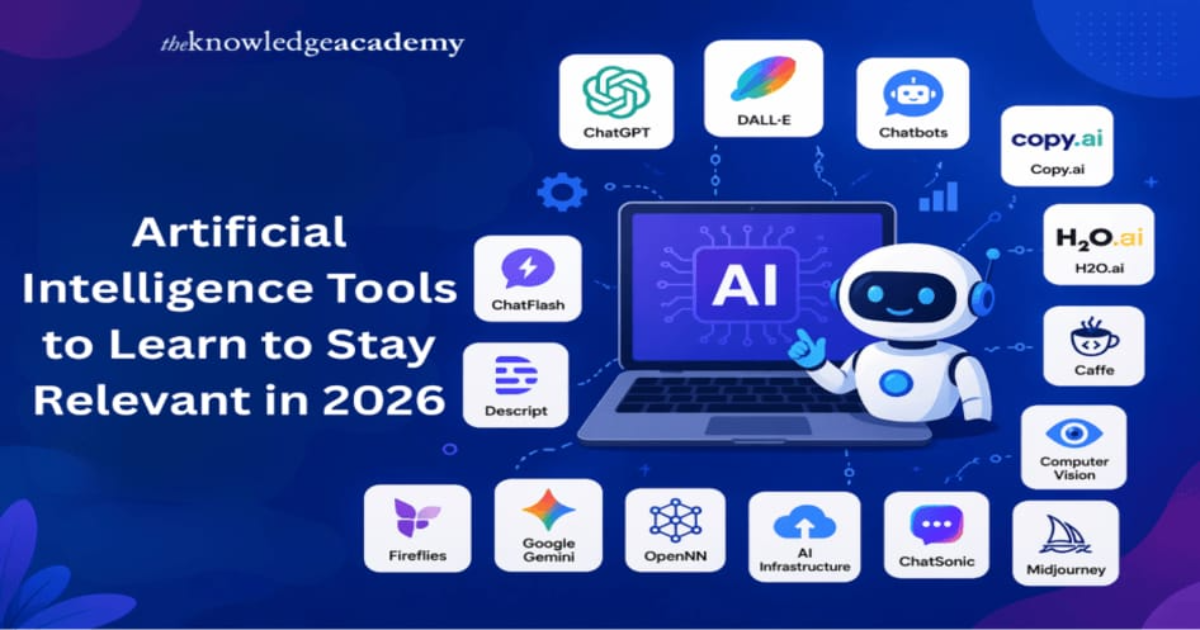
Have you ever noticed how quickly tools change the way work gets done? Artificial Intelligence Courses are helping professionals keep up with this shift, while also making sense of the real Goals of Artificial Intelligence in everyday tasks. From writing content to analysing data, AI tools are no longer optional. They are becoming part of daily work. The real question is not whether to use them, but which ones to learn first.
This blog explores the most useful tools that can help you stay relevant and confident in 2026. Let’s explore.
Top Artificial Intelligence Tools
Artificial Intelligence Courses at The Knowledge Academy can teach professionals how to use these tools in real life settings. The most popular AI tools that enable improved business outcomes, boost productivity, and enhance processes are listed below:
ChatGPT
It is a potent AI language model created by OpenAI for Communication and content production. It recognises context and offers Precise answers on a variety of subjects.
Key Features:
- Follows directions well and participates in organic, open-ended conversations
- Produces material, including creative writing, scripts, emails, and code
- Delivers insightful answers based on what is known
DALL·E
Another AI tool created by OpenAI is DALL·E, which generates visuals from text descriptions. It is quite useful for designers and content producers because it can create realistic or abstract graphics.
Key Features:
- Produces intricate images using straightforward text prompts
- Encourages a variety of artistic approaches
- Promotes exploration and inventiveness
Chatbots
Chatbots with AI capabilities mimic human speech or writing. They are frequently utilised in lead generation and customer service.
Key Features:
- Offers round-the-clock client service
- Effectively automates repetitious chores
- Customises interactions according to user activity
Copy.ai
An AI writing tool called Copy.ai assists with the creation of blogs, social media postings, product descriptions, and marketing copy.
Key Features:
- Let people select their writing style and tone
- Successfully plans out tasks and changes
- Multiple content formats are supported
H2O.ai
An open-source framework for creating and implementing machine learning models is called H2O.ai. Both novice and expert users can use it.
Key Features:
- Offers model visualisation and automated machine learning.
- Connects to well-known open-source frameworks
- Effectively scales for big datasets
Caffe
An open-source deep learning framework called Caffe is renowned for its effectiveness and speed, particularly in computer vision applications.
Key Features:
- Provides an adaptable and customisable architecture
- Allows for quick model deployment and training
- Backed by a robust development community
ChatFlash
Without the need for coding expertise, ChatFlash enables companies to develop AI-powered chatbots through machine learning and natural language processing.
Key Features:
- Development of no-code chatbots
- Multilingual assistance
- Integration with Slack and WhatsApp
Computer Vision
Machines can analyse and understand visual data from pictures and videos thanks to computer vision. It is extensively utilised in the retail, security, and healthcare sectors and closely relates to the Goals of Artificial Intelligence, including automation and more intelligent decision-making.
Key Features:
- Object and scene recognition
- Image and video classification
- Visual data segmentation
Descript
Descript is an AI-powered tool that makes editing audio and video content just as simple as editing text.
Key Features:
- Text-based editing of media
- Automatic creation of subtitles
- Media refreshes in real time based on script changes
Fireflies
An AI meeting assistant called Fireflies uses Zoom and Google Meet to record, transcribe, and summarise meetings.
Key Features:
- One-click meeting recording
- Accurate transcription
- Highlights key takeaways and action points
Google Gemini
It is a sophisticated artificial intelligence model that can comprehend and produce material in a variety of formats, such as text and images.
Key Features:
- Processes multiple data formats
- Delivers accurate and creative responses
- Handles complex queries effectively
OpenNN
Neural networks and predictive modelling are the main topics of OpenNN, an open-source deep learning package.
Key Features:
- Customisable neural network architectures
- Optimised for speed and performance
- Supports various neural network types
AI Infrastructure
The systems: hardware, software, and cloud platforms, that facilitate the development and expansion of AI models are referred to as AI infrastructure.
Key Features:
- Allows AI applications to scale effectively
- Increases the speed of inference and training
- Making accessibility possible via cloud-based solutions
ChatSonic
ChatSonic is an AI platform that uses conversational AI and real-time data access to improve consumer interactions.
Key Features:
- Reacts with emotional intelligence
- Automates communications with customer service
- Obtains current data from search engines
Midjourney
Midjourney is an AI picture production application that helps people realise their creative ideas by producing visuals from text prompts.
Key Features:
- Creates intricate pictures from words
- Creates realistic concepts and portraits
- Beneficial for artistic and educational endeavours
Conclusion
AI tools are no longer just helpful additions. They are becoming part of how work gets done across industries. Understanding them builds confidence and opens new opportunities. Learning through structured training helps turn this knowledge into practical skills. It also connects with the broader Goals of Artificial Intelligence, which focus on improving efficiency and decision making.
To build strong knowledge and stay updated, consider The Knowledge Academy, the best training provider, to guide your learning through Artificial Intelligence Courses and support your long-term growth in this evolving field. t training provider, to guide your learning through Artificial Intelligence Courses and support your long-term growth in this evolving field.


 Sky Bloom
 Umar Attique Shah