
 Alexa White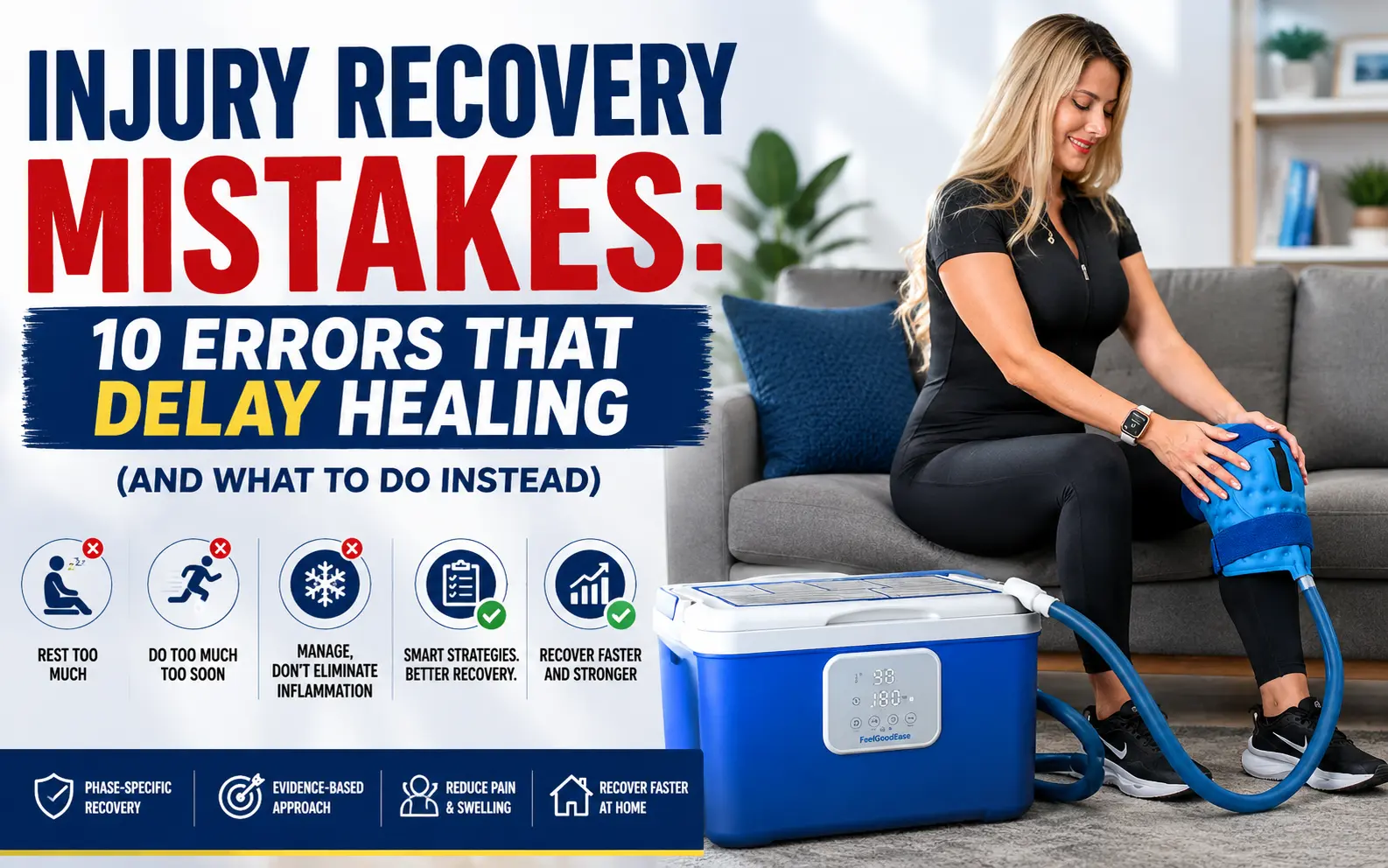
In most cases, people don’t struggle with injury recovery because they’re not trying hard enough.
They struggle because they’re trying the wrong things.
I see this all the time in clinical practice. Someone gets injured, starts resting, adds a bit of ice, maybe tries a few exercises and still, something feels off. Or they feel better for a few days, test it and suddenly the pain comes back worse.
- At that point, it starts to feel confusing.
- Should you rest more? Move more? Push through it?
- The problem is most of the advice out there doesn’t match how the body actually heals.
- Recovery isn’t driven by motivation.
- It’s driven by load.
👉 In my experience working with recovery tools like FeelGoodEase Cold Therapy Systems patients tend to get better results when they follow structured, phase-based strategies instead of reacting to symptoms day by day.
- What I consistently see are two patterns.
- Some people do too much, too soon. Others do too little, for too long.
- Both lead to the same outcome reduced tissue tolerance and delayed healing.
- And most of it comes down to one misunderstanding.
- Pain.
- People either try to push through it or eliminate it completely.
- Neither approach works.
- Pain isn’t something to ignore but it’s also not a green signal to progress.
- It’s feedback.
If you don’t use it correctly, you lose the most important guide your body gives you during recovery.
That’s why injuries that should take a few weeks often stretch into months.
In this article, I’m going to break down the most common mistakes I see during recovery what’s actually happening at a tissue level and what to do differently if you want steady, reliable progress.
Important: Recovery timelines vary depending on your injury, age and overall health. This article is based on clinical experience but it doesn’t replace personalized medical advice. Always consult your healthcare provider before changing your rehabilitation plan.
The Recovery Paradox: Why the Actions That Feel Productive Often Destroy Progress
How “Hustle Culture” Hijacks Rehabilitation
The “no days off” mindset conflicts with how tissue heals. Recovery requires controlled load not constant effort. Applying training intensity to injured tissue exceeds its tolerance and delays healing.
In my experience, one of the biggest disruptions to recovery today isn’t the injury it’s the mindset people bring into rehab.
Fitness culture rewards intensity, consistency and pushing limits. That works in performance training. It fails in early-stage recovery.
Healing tissue doesn’t respond to motivation. It responds to load specifically, the right load at the right time.
When I evaluate patients who keep relapsing, I see a consistent pattern they’re not under-committed they’re over-committed to the wrong strategy.
They’re trying to train tissue that still needs protection.
Why Feeling Busy Often Means You’re Overloading Tissue
Aggressive stretching. Constant mobility work. Repeatedly testing range.
It feels productive.
It isn’t.
Early in recovery, collagen fibers are disorganized and mechanically weak. Cross-linking hasn’t matured. When you push into end ranges or increase intensity too early, you’re not strengthening tissue you’re disrupting its structure.
That’s why symptoms often spike 24 hours later.
Not because the exercise was wrong but because the dose exceeded tissue tolerance.
One of the most common mistakes I see is confusing activity with progress.
More is not better.
Better is better.
The Social Media Detox Prescription
Reducing exposure to unrealistic recovery timelines lowers anxiety-driven decisions and helps maintain phase-appropriate load progression.
If your recovery decisions are being influenced by social media, you need to audit that input.
Here’s what I recommend in practice:
- Unfollow accounts promoting “rapid recovery” or fixed timelines
- Avoid transformation content without clinical context
- Stop comparing your timeline to different injury profiles
- Prioritize sources explaining load progression not just outcomes
Expert Tip:
Comparison culture doesn’t improve recovery decisions it accelerates premature loading and repeated setbacks.
Phase-by-Phase: Mapping Mistakes to Your Healing Stage
Inflammatory Phase (Days 1–7): When Total Rest Becomes Risky
Complete immobilization can slow recovery. Controlled, low-level movement maintains circulation, reduces stiffness and supports early healing without increasing tissue stress.
Mistake: Complete Immobilization
Fix: The Micro-Dose Movement Protocol
In the first few days, protection matters but so does controlled input. Total rest seems logical. In practice, it leads to stiffness, reduced circulation and early deconditioning.
Instead, I guide patients toward “movement snacks.” Small, frequent, sub-threshold movements that stay within pain limits.
A simple structure:
- Move the joint gently every 1-2 hours
- Keep pain ≤3/10
- Prioritize smooth, controlled motion not end range
- Stop before fatigue or compensation
This isn’t exercise.
It’s signaling.
You’re telling the body the tissue is safe to use so it adapts instead of shutting down.
Expert Tip: Replace “complete rest” with “movement snacks.” Low-load, frequent movement maintains function without disrupting healing tissue.
Managing (Not Eliminating) Inflammation
Inflammation is a necessary part of healing. The goal is to manage excessive swelling not eliminate the process entirely.
- One of the most common mistakes I see is aggressive inflammation suppression.
- Patients overuse ice, medication or complete rest to “shut it down.”
- From a clinical standpoint, that’s counterproductive.
- Inflammation initiates repair. It brings the cells required for tissue regeneration.
- If you suppress it too early or too aggressively, you interfere with that cascade.
The goal is control not elimination:
- Elevate when appropriate
- Use short, targeted cold exposure
- Introduce gentle movement to support circulation
Expert Tip: Respect the first 48-72 hours. This is an active biological phase manage symptoms but don’t interrupt the healing signal.
For patients who struggle to interpret day-to-day changes, I recommend simple tracking.
Apps like PainScale or Bearable help identify patterns instead of reacting to single-day fluctuations.
Proliferative Phase (Days 7–21): The False Security of “Feeling Better”
Pain reduction during this phase does not mean the tissue is ready for full load. Collagen is being produced, but it is still weak and disorganized. Premature loading at this stage commonly leads to re-injury or long-term instability.
In this phase, I see one of the most predictable mistakes in recovery. Pain drops. Swelling improves. Movement feels easier.
So patients assume they’re ready.
They’re not. What’s actually happening is collagen production not collagen strength.
The body is laying down new fibers, but they are thin, randomly aligned and mechanically fragile. They haven’t developed proper cross-linking or load tolerance yet.
From a clinical standpoint, this is a high-risk window.
Here’s a scenario I see repeatedly.
A 28-year-old recreational runner with a grade II ankle sprain starts feeling better around day 10. Swelling is reduced. Walking is mostly pain-free. They attempt a light jog.
It feels fine during the run.
The next morning, stiffness increases. By day three, instability appears. Within a week, they’re back at baseline or worse with reduced tissue tolerance.
That’s not bad luck.
That’s premature loading on immature tissue.
Why Visible Improvement Hides Functional Deficits
Pain reduction creates a false sense of readiness. But function and pain are not the same metric.
Clinically, several deficits are still present:
- Reduced tensile strength – collagen cannot yet tolerate dynamic load
- Impaired proprioception – joint awareness remains limited
- Delayed motor control – stabilizing muscles are not coordinating efficiently
- Low load tolerance – capacity has not been rebuilt progressively
You feel better.
But you’re not functioning better yet.
Remodeling Phase (Week 3-6+): The Quiet Errors That Cause Recurrence
Return to sport should be based on objective functional benchmarks not time or symptom relief. Without meeting these criteria, re-injury risk remains high even when pain is minimal.
Mistake: Returning to Sport Before Milestones
Fix: Functional Testing Benchmarks
By the remodeling phase, tissue is stronger but still adapting to load. This is where impatience becomes subtle. Symptoms are minimal. Confidence returns. Validation gets skipped.
In practice, I never clear a patient based on how they feel. I clear them based on what they can demonstrate.
A simple checklist I use:
- Full, pain-free range of motion under load
- Strength symmetry ≥85-90% vs. the uninjured side
- Single-leg balance (30-45 seconds) without compensation
- Single-leg hop test symmetry ≥90%
- No increase in pain or swelling 24 hours post-activity
If these aren’t met, return to sport is premature. Even if it feels acceptable.
Mistake: Ignoring the Biomechanical Root Cause
Fix: The Movement Audit
Injury is rarely random. It’s usually the result of repeated stress applied through inefficient movement. Recovery is not just about healing tissue. It’s about correcting the system that caused the overload.
Here’s how I approach it:
- Identify movement breakdowns (e.g., knee valgus, poor ankle control)
- Assess strength asymmetries across key muscle groups
- Rebuild patterns with controlled, low-load exercises
- Progress into functional, sport-specific movement
- Re-test under fatigue conditions
This is where long-term outcomes are decided.
If you skip this step, the same load will produce the same injury.
Expert Tip: Use recovery time to correct the deficits that caused the injury movement patterns, strength imbalances and control issues. Address the “why,” not just the “what.”
Managing (Not Eliminating) Inflammation
Inflammation is necessary for healing. The goal is to control it not eliminate it. One of the most common mistakes I see is aggressive inflammation suppression. Patients overuse ice, medication or complete rest.
That’s not the goal.
Inflammation is the trigger for repair.
👉 In cases where consistency matters, I often recommend using a cold therapy machine for knee recovery instead of standard ice packs as it allows controlled temperature application and longer sessions without irritating the tissue.
Based on clinical use, consistency matters more than intensity.
What you should focus on instead:
- Elevation
- Controlled cold exposure
- Gentle movement
The Physical Errors: Movement, Load and Pain
Returning to Activity Too Aggressively
Returning too quickly creates a re-injury cycle where short-term improvement is followed by increased pain and reduced tissue tolerance. The issue is not activity itself but exceeding current load capacity.
In practice, re-injury rarely comes from one extreme mistake. It’s usually a sequence of small, premature decisions.
You feel better. You test the joint. You add intensity. Then you push slightly further because doing less feels like losing progress.
This is where identity becomes a factor.
If your progress is tied to performance, you’re more likely to overload tissue before it’s ready. Not because you’re careless but because you’re trying to return to normal too quickly.
That creates a predictable cycle:
- Symptoms decrease
- Load increases too quickly
- Tissue fails to tolerate stress
- Pain returns, often worse
That’s not a rehab failure.
It’s a load timing error.
Confusing Complete Rest with Strategic Movement
Complete rest reduces tissue capacity over time while controlled, sub-threshold movement maintains circulation, mobility and neuromuscular function without causing damage.
From a recovery perspective both extremes create problems.
Complete Immobilization
- ✔ Reduces short-term irritation
- ✖ Leads to stiffness and reduced circulation
- ✖ Accelerates muscle atrophy and joint restriction
Controlled Movement (Sub-Threshold Loading)
- ✔ Maintains mobility and blood flow
- ✔ Preserves neuromuscular activation
- ✔ Gradually rebuilds tissue tolerance
- ✖ Requires discipline to stay within limits
The goal isn’t to avoid movement.
It’s to dose it correctly.
Using Anti-Inflammatories to Mask Pain Signals
NSAIDs can help manage excessive inflammation early on but overuse may mask pain signals and lead to unintentional overloading of healing tissue.
Myth vs. Fact
Myth: If pain is reduced, the tissue is ready for more load.
Fact: Pain relief does not equal structural readiness.
Myth: Anti-inflammatories accelerate healing.
Fact: They reduce symptoms, but excessive use may interfere with the inflammatory processes required for repair.
In practice, I often see patients treat pain relief as a green light. That’s where problems start.
Pain is feedback. If you suppress it without adjusting load, you’re operating without reliable signals.
Abandoning Home Exercises When Symptoms Fade
Stopping rehab too early prevents proper tissue remodeling, increasing the risk of recurrence even when pain has resolved.
This is one of the most consistent drop-off points.
Symptoms improve, so adherence drops.
From what I’ve observed, compliance with home programs can fall by over 50% once pain decreases. The problem is that remodeling is still ongoing even when everything feels normal.
If loading stops too early:
- Collagen remains poorly organized
- Strength deficits persist
- Load tolerance plateaus
You don’t notice it immediately. You notice it when you return to full demand.
A simple intervention I recommend is tracking. Even a basic daily log exercise, pain response, next-day symptoms improves consistency and decision-making.
Contralateral Training: Loading the Uninjured Limb to Preserve the Injured Side
Training the uninjured limb helps preserve strength and neuromuscular function in the injured limb through cross-education.
This is one of the most underutilized strategies in rehab.
When one limb is injured most people reduce overall training.
That’s a mistake.
The nervous system allows strength gains from one side to partially transfer to the other. This helps maintain capacity without directly stressing the injured tissue.
A simple protocol:
- Train the uninjured limb 3–4 times per week
- Use moderate to high intensity (as tolerated)
- Emphasize controlled, full-range movement
- Include both strength and stability work
- Monitor fatigue to avoid systemic overload
This keeps the system active while protecting the injury.
Expert Tip: Train the uninjured side with intent. Cross-education preserves strength, coordination and neural drive reducing long-term deficits.
For structured progression, align with established rehabilitation frameworks (e.g., JOSPT, Cochrane) when designing unilateral and corrective programs.
The Hidden Recovery Killers: Sleep, Nutrition and Psychology
Nutritional Gaps That Stall Tissue Regeneration
Tissue repair depends on consistent protein intake and adequate calories. Irregular eating patterns or dieting during recovery reduce muscle protein synthesis and slow healing.
Protein Distribution and Muscle Protein Synthesis
Most patients I see don’t have a protein deficiency.
They have a timing problem.
They consume minimal protein during the day, then concentrate it in one large evening meal. From a recovery standpoint, that approach is inefficient.
Muscle protein synthesis is not a single event it’s a repeated process that needs consistent stimulation throughout the day.
If intake is delayed, those repair opportunities are lost.
Actionable Tip: Aim for 20-40g of protein every 3-4 hours during waking hours to maintain a steady repair signal.
Expert Tip: Consistency drives tissue repair not volume in a single meal.
Caloric Deficits During Healing
A calorie deficit during recovery reduces the body’s ability to repair tissue, maintain muscle and adapt to rehabilitation loads.
This is where intention often conflicts with physiology. Many patients try to “stay lean” while activity is reduced. But healing is energy-dependent.
If intake is too low:
- Tissue regeneration slows
- Muscle breakdown increases
- Recovery timelines extend
From a clinical perspective, recovery is not the time for aggressive dieting. It’s the time to support adaptation.
Key Takeaway:
Maintain at least maintenance-level calories during rehab. Healing requires adequate energy availability.
For objective tracking, tools like Cronometer can help verify protein intake and caloric needs.
Disrupted Sleep and Missed Hormonal Repair Windows
Deep sleep is critical for recovery. Growth hormone release and tissue repair peak during these cycles and poor sleep directly delays healing and increases inflammation.
Sleep is often treated as optional.
It isn’t.
From a physiological standpoint some of the most important repair processes occur during deep sleep.
This is when growth hormone is released in pulses, supporting:
- Tissue regeneration
- Muscle repair
- Inflammation regulation
If sleep is fragmented or shortened, those processes are disrupted.
You can follow a perfect rehab plan but without sleep, adaptation is limited.
Expert Tip: Treat 7-9 hours of quality sleep as a non-negotiable part of recovery. It is active biological repair not passive rest.
Sleep tracking tools and CBT-based apps can help identify disruptions and improve sleep quality when needed.
Psychological Distress and Identity Loss After Injury
Anxiety-Driven Overtraining
Fear of losing fitness often leads to premature loading, which exceeds tissue tolerance and delays recovery.
This is where physical and psychological errors intersect. When identity is tied to performance, inactivity feels like regression.
That pressure drives behavior:
- Testing limits too early
- Increasing load without progression
- Ignoring delayed pain signals
From the outside, it looks like discipline.
Clinically, it’s misdirected load.
Depression-Driven Sedentary Behavior
Reduced activity, loss of routine and social isolation can lead to depressive patterns that reduce rehab adherence and slow recovery.
- On the opposite end, some patients disengage entirely.
- Injury disrupts structure. It limits movement. It reduces social interaction.
- That combination shifts behavior quickly.
- Missed sessions turn into prolonged inactivity.
- Without consistent input, tissue cannot adapt.
- Recovery is not just physical it’s behavioral consistency over time.
Kinesiophobia and Fear of Re-Injury
Fear of movement reduces loading, which lowers tissue capacity and prolongs recovery. Gradual, controlled exposure rebuilds both function and confidence.
Fear after injury is expected. But when it controls decision-making, it becomes a barrier.
Avoidance doesn’t protect recovery.
It delays it.
The solution is graded exposure:
- Start with low-risk, predictable movements
- Keep load well below pain threshold
- Repeat consistently to build confidence
- Gradually increase complexity and intensity
- Reassess response after each progression
This restores both physical capacity and psychological trust.
Expert Tip: If fear is limiting progress, use structured graded exposure with clinical guidance. Controlled loading rebuilds both tolerance and confidence.
Mental health support can also play a role. Tools like Headspace or clinician-led counseling help address psychological barriers that physical rehab alone cannot resolve.
When Your Support System Sabotages Recovery
The Over-Coddling Trap: When Rest Becomes Enabling
Excessive protection from family or partners reduces necessary movement, leading to stiffness, poor circulation and delayed tissue adaptation.
In practice, I often see well-meaning support systems unintentionally slow recovery.
They discourage movement. They reinforce rest. They treat the injury as something fragile that must be protected at all costs.
That creates underloading. And underloading reduces tissue tolerance just as much as overloading does.
Recovery requires input. Without it, the body has no reason to adapt.
Toxic Positivity and Pressure to “Tough It Out”
External pressure to “push through” ignores tissue healing timelines and often leads to premature loading and re-injury.
On the other end, I see a different kind of problem.
Coaches, teammates even friends pushing for a faster return.
“You look fine.”
“Just test it.”
“You’ll loosen up once you start.”
- That language ignores physiology.
- Tissue doesn’t adapt because you’re motivated.
- It adapts because it’s ready.
How Coaches and Partners Prematurely Encourage Loading?
This is where boundaries matter. If your environment is shaping your decisions, you need to control the message.
Here are practical scripts I recommend patients use:
- “I’m following a phased rehab plan progression is based on function not time.”
- “My PT has set load limits right now. Pushing past them will delay recovery.”
- “I’m not avoiding activity I’m controlling it to avoid restarting the injury cycle.”
- “I’ll return when I meet strength and stability benchmarks not just when it feels okay.”
This isn’t being overly cautious.
It’s being precise.
Myth vs. Fact: Evidence-Grade Reality Checks
Myth: Aggressive Ice Baths and Supplement Stacks Accelerate Healing
Physiological Reality: Healing is driven by cellular signaling, controlled inflammation and progressive loading not extreme interventions. Excessive cold exposure may blunt inflammatory signals required for repair.
Correction: Use targeted, time-limited cold exposure for symptom control not as a primary recovery strategy.
Evidence Level: Moderate (systematic reviews show variable outcomes depending on timing and dosage)
Myth: If Swelling Is Down, You’re Ready to Load
Physiological Reality: Reduced swelling does not reflect internal readiness. Collagen structure, tensile strength and neuromuscular control may still be insufficient.
Correction: Progress based on function strength, control and load tolerance not visual improvement.
Evidence Level: Strong (RCTs and sports medicine guidelines support functional criteria)
Myth: Pain During Exercise Means You’re “Breaking Through”
Physiological Reality: Sharp, localized pain is a warning signal of tissue overload not progress. Only controlled, low-level discomfort may be acceptable.
Correction: Use pain quality and behavior not just intensity to guide progression.
Expert Tip: Sharp, pinpoint pain with a clear trigger means stop. Diffuse muscular soreness that doesn’t alter movement is typically safe to monitor.
Evidence Level: Strong (pain science and clinical guidelines)
The Symptom-Based Decision Framework
The Two-Hour Pain Rule: Your Primary Recovery Compass
If pain or swelling increases within two hours after activity not just during you’ve exceeded tissue tolerance and should reduce load.
In clinical practice, I don’t rely on how something feels during activity alone. Delayed response is more reliable.
For example:
If you complete a session and feel fine but pain increases later that day or the next morning that’s a clear signal the load was too high.
Expert Tip: Use the two-hour window as your checkpoint. Immediate comfort does not equal safe progression.
Pain vs. Soreness Mapping
Understanding this distinction changes decisions:
- Benign soreness: Diffuse, dull, symmetrical, improves with light movement
- Warning pain: Sharp, localized, triggered by specific movement
- Safe discomfort range: ≤3/10 without compensation
- Red flag: Pain that alters movement mechanics
Pain isn’t the problem. Misinterpreting it is.
Warning Signs vs. Normal Sensations: Quick Reference Guide
| Symptom | Normal Recovery Sensation | Warning Sign | Immediate Action |
|---|---|---|---|
| Pain (2 hrs post) | Mild soreness that stabilizes or decreases | Sharp or increasing pain/swelling | Stop 24-48 hrs reduce load |
| Morning stiffness | Resolves within 10-20 minutes | Lasts >45 minutes or worsens | Reduce load by 30-50% |
| Swelling | Mild, fluctuating | Persistent, tense, increasing | Elevate, compress, stop loading |
| Pain during exercise | ≤3/10, no compensation | Sharp, alters movement | Stop immediately |
| Muscle soreness | Peaks at 24-48 hours | Lasts >72 hours, worsening | Deload and reassess |
| Heat at injury site | Mild (first 48-72 hours) | Persistent or increasing | Seek medical review |
| Joint clicking | Painless, occasional | Painful, locking, instability | Stop loading, assess clinically |
This framework removes guesswork. It gives you a system to adjust load based on how tissue responds not how it feels in the moment.
Your Personalized Recovery Toolkit
The Recovery Persona Quiz
Recovery mistakes are predictable. Identifying your behavior pattern helps you correct load, movement and decision-making errors before they delay healing.
In practice, most patients don’t fail randomly. They repeat patterns. Not because they lack discipline but because they default to habits under uncertainty.
Use this quick self-assessment:
Which one sounds like you?
1. The Overeager Athlete
- Returns to activity as soon as pain decreases
- Frequently tests limits
- Struggles to reduce intensity
Correction Strategy: Follow load progression rules not how you feel. Use objective benchmarks before increasing intensity.
2. The Passive Rester
- Avoids movement due to fear
- Waits for “zero pain” before acting
- Gradually loses strength and mobility
Correction Strategy: Introduce structured, sub-threshold movement daily. Build tolerance through consistent exposure.
3. The Supplement Stacker
- Relies heavily on tools, supplements or “shortcuts”
- Prioritizes passive recovery over active rehab
Correction Strategy: Refocus on fundamentals movement, load, sleep and nutrition. Tools support recovery; they don’t drive it.
4. The Inconsistent Rehabbing Patient
- Starts strong then drops off as symptoms improve
- Skips progression and structure
Correction Strategy: Use tracking systems and fixed routines to maintain consistency through the remodeling phase.
Phase-Specific Recovery Protocol Checklist
Recovery must match the healing phase. Each stage requires a different balance of protection, movement and load progression.
Inflammatory Phase (Days 1-7)
- Protect the area without full immobilization
- Perform “movement snacks” every 1-2 hours
- Keep pain ≤3/10 during activity
- Use short, targeted cold exposure if needed
- Prioritize sleep, hydration and basic nutrition
Proliferative Phase (Days 7-21)
- Avoid premature return to full activity
- Introduce controlled, low-load strengthening
- Focus on movement quality not intensity
- Monitor delayed pain response (2-hour rule)
- Maintain consistent protein intake
Remodeling Phase (Week 3-6+)
- Progress load based on function not time
- Introduce strength, balance and coordination work
- Use objective benchmarks before returning to sport
- Address movement inefficiencies and imbalances
- Gradually reintroduce sport-specific tasks
For advanced progression, structured frameworks like graded exposure and blood flow restriction (BFR) training can help maintain muscle adaptation while minimizing joint stress when applied correctly.
The Mistake Audit: A Daily Recovery Journal
Tracking daily inputs and symptoms improves decision-making and prevents repeated recovery mistakes.
One of the most effective tools I use with patients is simple:
A daily log. Because recovery is not defined by single sessions but by patterns over time.
Your tracker should include:
- Pain level (during + 2 hours after activity)
- Sleep duration and quality
- Protein intake and meal distribution
- Movement or exercises completed
- Swelling, stiffness or symptom changes
- Mood and energy levels
This turns recovery into a system. Not guesswork. Think of it as your “Mistake Audit” a way to identify patterns early and adjust before small errors become setbacks.
Conclusion
Recovery rewards precision not effort alone. I’ve seen patients delay healing not because they lacked discipline but because they applied effort in the wrong direction.
The paradox is simple.
The actions that feel productive pushing harder, doing more testing limits are often the ones that reset progress.
Healing is not linear.
Discomfort is not always damage. And the absence of pain is not proof of readiness. If you want consistent progress, match load to your phase use symptoms as data and prioritize controlled progression over urgency.
Use this framework as a guide.
But for best outcomes, align your plan with your specific injury, history and physiology ideally with input from a qualified healthcare professional.
FAQs: Injury Recovery and Healing
How do I know if I’m progressing correctly in recovery?
Progress is measured by improved function not just reduced pain. If you can tolerate slightly more load, maintain movement quality and avoid increased pain or swelling within 2 hours after activity, your recovery is on track.
Is it normal for pain to come and go during recovery?
Yes. Fluctuating symptoms are normal. Focus on the overall trend if pain is gradually decreasing and function is improving, you’re progressing. Increasing pain, swelling or loss of function suggests load may be too high.
When should I stop exercising an injured area?
Stop immediately if you feel sharp, localized pain, instability or movement compensation. Mild discomfort (≤3/10) that does not worsen after activity is generally acceptable within controlled limits.
Can I speed up recovery with ice baths or supplements?
No single method significantly accelerates healing. Recovery depends on proper load management, sleep and nutrition. Over-reliance on passive tools can distract from the factors that actually drive tissue adaptation.
How long does injury recovery usually take?
Recovery timelines vary based on injury type, severity and individual factors. Most soft tissue injuries follow healing phases but progression should be based on function not fixed timelines.
Should I continue exercises even if I feel better?
Yes. Pain reduction does not mean full recovery. Continuing structured rehab through the remodeling phase is essential to restore strength, stability and prevent re-injury.
What’s the difference between soreness and harmful pain?
Soreness is typically dull, diffuse and improves with movement. Harmful pain is sharp, localized and often worsens with specific movements or over time. Distinguishing between the two is critical for safe progression.
Can I train other parts of my body during recovery?
Yes. Training uninjured areas helps maintain overall fitness and supports recovery through cross-education effects. Avoid stressing the injured tissue directly.
How important is sleep in injury recovery?
Sleep is essential. Most tissue repair and growth hormone release occur during deep sleep. Poor sleep slows healing and increases inflammation.
When should I see a healthcare professional?
Seek professional help if pain persists longer than expected, worsens with minimal activity or if you experience instability, significant swelling or loss of function.

 alishanasir237@gmail.com
 Sky Bloom