
 alishanasir237@gmail.com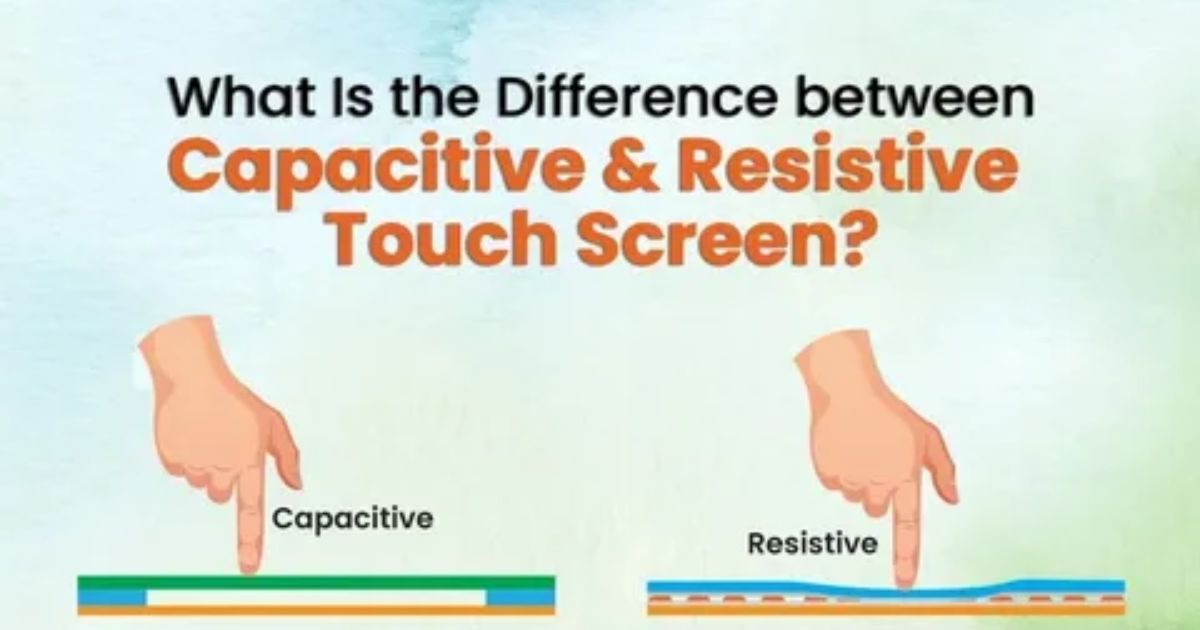
Introduction
There is a touchscreen technology on almost every device nowadays! Other applications include use in smartphones and tablets, methods in ATMs, medical devices, and industrial machines. There are various touch screens suitable for various applications.
There are two prevalent technologies in the market today: capacitive and resistive touchscreens. They are both user-interactive; they work differently.
In many instances, it will be helpful for businesses and users to understand their differences in order to select the appropriate display technology.
What is a Capacitive Touchscreen?
Examples of capacitive touchscreens include those that detect electric changes in a human body.
The screen is made of a transparent conductive layer. If somebody touches the surface, the electric field will change.
Typical applications of capacitive screens are:
- Smartphones
- Tablets
- Smartwatches
- Kiosks
A Capacitive Touchscreen TFT Display is a quality touchscreen that offers excellent visual performance along with touch functionality. These types of displays are favored due to their level of smoothness and responsiveness.
What is a resistive Touchscreen?
A resistive touchscreen is an electronic display that communicates via pushing. It is composed of two layers of conductibles with a small side-to-side gap. Under pressure, the layers will touch. This will send the touch signal.
Resistive screens are capable of being used with:
- Finger
- Stylus
- Gloves
- Any pointed object
They feature in many industrial/medical machines.
Capacitive Touchscreens vs Resistive Touchscreens
The primary difference between capacitive vs resistive touchscreens lies in their operation. The main difference between capacitive and resistive screens is how they work.
Touch Method
- Capacitive screens are there to measure electrical conductivity.
- Resistive screens can be used to measure pressure forces.
Sensitivity
- Capacitive screens are more receptive and have a higher sensitivity.
- For resistive screens, the amount of force needed is greater.
Multi-Touch Support
- Capacitive screens allow multiple fingers to be used for various gestures.
- Typically, the resistive screens are designed for a single touch of the screen.
Display Clarity
- There is superior brightness and clarity with capacitive screens.
- Any resistive screens might cause some loss of crispness.
The differences have an impact on the user experience and suitability of applications.
Benefits of Capacitive Touchscreens:
There are a number of advantages to capacitive technology.
- High Sensitivity
Easily responds to light touches.
- Better Image Quality
Visuals make things clearer, making the user experience better.
- Multi-Touch Capability
Pinching, zooming, and swiping are easy processes.
- Durable Surface
Glass surfaces aren’t as prone to scratching.
Capacitive screens are best suited for use in consumer electronics because of these attributes.
Benefits of Resistive Touchscreens :
There are also some beneficial features related to resistive technology.
- Works With Gloves
It helps in the industry and the medical field.
- Lower Cost
Usually, resistive screens could be more inexpensive.
- Stylus Compatibility
Usable precision input can be achieved using stylus pens.
- Broad Input Options
The screen can be turned on by any object.
The advantages of these benefits allow resistive screens to be used in special applications.
Applications of Capacitive Touchscreens
Capacitive screens are used in a large variety of:
- Smartphones
- Tablets
- POS systems
- Interactive kiosks
- Automotive displays
Today, Capacitive Touchscreen TFT Display is often chosen for high-end products that are concerned with the smoothness of touch response.
Applications of Resistive Touchscreens:
A wide variety of applications that feature resistive screens include:
- Medical devices
- Industrial equipment
- GPS systems
- ATMs
- Control panels
This type of environment may involve wearing gloves or inputting with a stylus.
Which is better compared to the others?
This is subjective and depends on the users’ application requirements.
Switch on to capacitive touchscreens for:
- Fast response
- Multi-touch support
- Better display quality
If you require them, opt for resistive touchscreens:
- Lower cost
- Stylus input
- Glove compatibility
The selection must be in line with product objectives and user needs.
The future of touchscreen technology.
Touchscreen technology is continually being developed.
Future trends include:
- Flexible touch displays
- Ultra-thin sensors
- Improved gesture control
- AI touch optimization
At present, Consumer markets are dominated by capacitive technology.
Conclusion
Both capacitive and resistive touchscreens are good, too. The distinction is mainly in the sensitivity, cost, durability, and application.
This Capacitive vs Resistive Touchscreens comparison enables users to have a good understanding of the technology that best fits their requirements.
Capacitive Touchscreen TFT Display solutions are still a popular option for high-end electronics and sophisticated interfaces, because they are both responsive and visually high-quality.


 Umar Attique Shah